
The Lineage vision
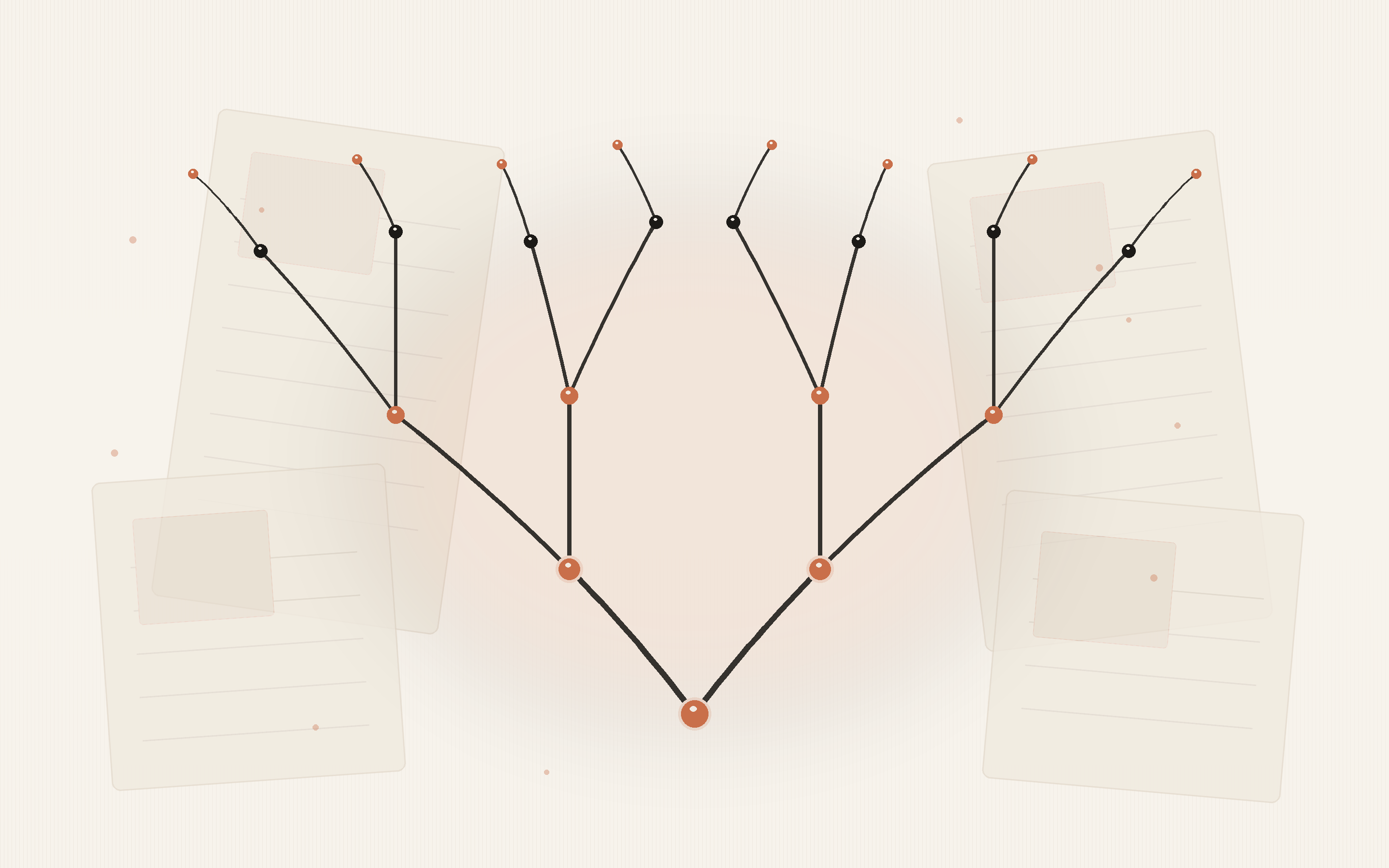
What Lineage is for, the five parts we are building, how it differs from the rest of the market, and our plan to document every decision so better agents can build better versions of it.
Lineage began with one recording. I sat down with my father and recorded a conversation that ran three and a half hours. Then I gave the recording to AI agents.
What came back surprised me. The agents turned the conversation into stories, chapters and a family record. Then they started sub-agents of their own, which went looking for what the recording mentioned: names, towns, ships, regiments. They found records in archive after archive, spread across collections I had never heard of. I had no idea how much was out there, or how scattered it was.
That is the reason for Lineage. I wanted other families to have what I had, without having to build it themselves.
Where family history stands
Family history has always lived in three places at once. Some of it is in the shoebox: photographs, letters, a recorded conversation with a grandparent. Some of it is on the big genealogy platforms, which hold the most digitized collections. The rest, and there is a great deal of it, sits in thousands of small archives: county courthouses, church registers, local newspapers, historical societies, regimental records. Most of it has never been indexed, searched or put on the open internet. We call it dark data.
The market built around this is small, and in our view a little sleepy. It is organized around trees and subscriptions, not around going out and finding what nobody has looked at yet. Agentic research changes that. An agent can read a catalog, follow a lead, search every spelling a clerk might have used, and keep going. We think every family is about to get access to the kind of finds that used to take a professional researcher years, and we want to make that real.
The five parts of Lineage
1. The Lineage API. One API that any agent can use to reconstruct a family's history the way I did. A prototype is already released. The goal is to be the OpenRouter of genealogical research: one key, and behind it the whole scattered world of records, including the dark data nobody else has indexed. Every result is cited, and the API will never research a living person.
2. Data services. Families should own and control their own family data. It should be portable, archivable and theirs to take anywhere. We are starting with Google Drive: your originals, the index of what is in them, and everything Lineage derives from them, stored in your own Drive.
3. The research agent. An agent that follows a planned graph of steps to track down records on dozens of relatives, or hundreds. It harvests what is available, public and private where you have access, brings it back, and stores and indexes it in your own archive through the data services.
4. A hosted family archive. Anyone can set up a family archive, public or private, as they choose. It includes a Familypedia, writing about the family's history built only from sourced facts, and a record of every source and archive it drew on. It is a family treasure trove you can shape to your family, protected from deletion, shareable across branches of the family, so the stories carry across generations.
5. Tools for the people who remember. In most families, someone holds the history in their head. Memoir and story tools let that person tell it into the app. What they say becomes part of the record, and it sends the research agent off to find what is missing.
Who it is for
Our first user is the archivist. Most families have one: the person who took it on themselves to dig into the family history. Maybe they have a few pieces. Maybe they have boxes.
We want to do two things for that person. First, dramatically extend how far and how wide their research can go. Second, help them turn what they find into things the rest of the family will actually read, keep and enjoy, at every age: chapters, a family site, newsletters, an audio story.
The goal under both is simple. Family lore should never be lost again. Every family should have a permanent record of the interesting details of its past, captured, indexed and presented.
How we plan to build it
We expect progress in AI to lead to a period of self-improving systems, where AI can build better versions of the tools it is given. If that is right, the most valuable thing we can do now is write down what we intend, clearly and completely.
So we are documenting every feature as a Lineage Improvement Proposal, or LIP: what it is, why we chose it, the sources and reasoning behind it, the edge cases and the tests. The LIPs live in our GitHub. We will record our strategy, research and lessons as we go. As AI improves, we will hand this record back to it and ask it to build better versions of every part of Lineage: the API, the data services, the agent and the hosted archives, until most of the work can be handed to agents entirely.
The most important LIP is the first one: a self-improving loop, in which agents research, test and improve the platform on their own schedule, and every step is checked.
Where we are
We are at stage one. That means setting out the vision and building the first version of each part: search, data services, the agent, the home page, the first hosted experience and the first story generation. Alongside that, we are writing the LIPs that say where each part goes next.
The handoff to agents has not happened yet. Our guess is that self-improving versions of a platform like this become possible somewhere in the next three to six months. Our job now is to have the groundwork in place when they do.
What is hard
The biggest challenge so far is that agentic research takes know-how: what agents can do, how to ask them for records, and how to set them going so they keep improving their own search. That is the problem we most need to solve, so a family does not need to be an agent expert to get results.
The API works, and it is also very incomplete. We have significant work ahead on data storage, data indexing, story generation and more.
What happens next
For now, we will be finding our first users, sitting down with them, working through the hard details and smoothing out the product. If you are the archivist in your family, we would like to hear from you.
Stick around. We look forward to serving you as well as we can.